



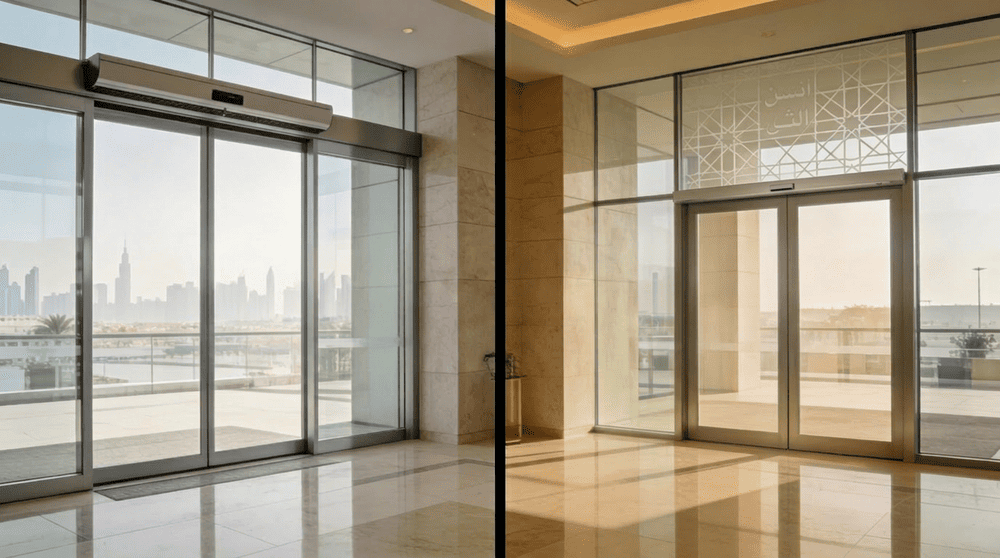
Choosing the right automatic door system affects daily traffic flow, accessibility, safety, energy efficiency, and the overall entrance experience. In the UAE—where air‑conditioned interiors, high footfall locations, and premium building finishes are common—the choice between automatic swing doors and automatic sliding doors should be based on space planning, usage patterns, and correct safety setup. This guide compares swing vs sliding automatic doors with practical pros/cons and where each option works best—especially for hospitals, offices, and controlled access areas.
The key difference: how each door opens / swing vs sliding
An automatic sliding door opens by moving one or more door leaves sideways along a header/operator. This makes it a popular choice for busy entrances because people can move through without needing to step back for a swing path.
An automatic swing door opens on hinges (in‑swing or out‑swing) using a swing operator. It needs clear space for the door’s swing arc, but it can be ideal where side space is limited or where a traditional hinged‑door look is preferred.
Automatic sliding doors: advantages and limitations
Pros
-
Smooth flow in busy entrances: Sliding doors support continuous movement and are commonly selected for high‑traffic entry points.
-
Comfortable clear opening: Bi‑parting or multi‑leaf configurations can provide wide openings for users with mobility needs and for carts/trolleys.
-
Modern entrance experience: Sliding systems are frequently used to create a clean, premium first impression in commercial settings, especially for swing vs sliding applications.
Cons
-
Side space requirements: Sliding leaves need room to “stack” when open; if the opening is tight, you may need telescopic designs or fixed panels.
-
Entrance performance needs planning: If air leakage control or pressure differences are a concern, the entrance layout (and sometimes vestibule planning) becomes important when choosing swing vs sliding solutions.
Automatic swing doors: advantages and limitations
Pros
-
Works when side space is limited: Swing doors don’t need the same run‑off space beside the opening that sliding leaves often require.
-
Good for upgrades: Many swing solutions can be added to suitable existing hinged doors, making them practical for renovations.
-
Strong fit for controlled entry points: Swing doors are commonly used for access‑controlled internal openings where defined open/close operation is desired, offering a clear swing vs sliding alternative.
Cons
-
Swing arc clearance is mandatory: The door path must remain clear, which affects corridor planning, furniture placement, and adjacent door conflicts.
-
Safety design is critical: Automatic swing doors can create pinch/crush zones around the hinge and closing edge, so sensor selection, placement, and correct door settings matter, particularly when comparing swing vs sliding safety requirements.
Space planning checklist (UAE project‑friendly)
Before selecting swing or sliding, confirm these points early to avoid costly redesign later:
-
Traffic level: Constant two‑way peak flow often favors sliding doors at main entrances; moderate flow or controlled movement may suit swing doors, especially in swing vs sliding layouts.
-
Available space: Sliding doors need side stacking space; swing doors need clear swing‑path space.
-
Safety and sensors: Plan activation and presence protection together with ceiling coordination, frames, and finishes so coverage is not compromised, whether you choose swing vs sliding solutions.
-
Sealing requirements: If your project needs stronger separation for air‑conditioning performance, odor control, or noise reduction, evaluate which door type (and which sealing strategy) fits the space and performance target, since this can influence swing vs sliding selection.
-
Integration needs: Consider access control, emergency/egress behavior, and interfaces with building systems early, because they can influence operator choice and configuration in swing vs sliding installations.
Best applications: hospitals, offices, and controlled access
Hospitals and healthcare facilities
A common approach is sliding doors for busy public entrances and circulation areas, while swing doors can work well for internal openings depending on layout and workflow needs. Where hygiene and airtight performance are priorities (such as cleanroom‑type environments), specialized door systems designed for stronger sealing are often used, making swing vs sliding a critical decision.
Offices and commercial buildings
Sliding doors are frequently used for lobby entrances to support smooth peak‑time movement and a modern, high‑end entry experience. Swing doors can be a strong option for internal areas, tenant entries, and places where side space is restricted and a hinged‑door format fits the layout, and they are often preferred in swing vs sliding comparisons for these spaces.
Controlled access areas
Swing doors are commonly used for controlled entry points inside buildings, offering a straightforward, single‑opening approach that suits restricted zones. Sliding doors can also be used when the priority is fast, comfortable throughput at perimeter entrances—provided safety planning and operational settings are coordinated correctly. This makes swing vs sliding a key consideration for controlled access environments.
Conclusion
Automatic sliding doors are typically the better choice for main entrances that need high‑throughput, smooth two‑way movement and wide, welcoming openings. Automatic swing doors are often the better fit when side space is limited, when a hinged‑door format suits the architecture, or when you need a controlled internal doorway with clear operational behavior. The best results come from matching the door type to traffic patterns and space constraints, then finalizing the operator, sensors, and settings as one coordinated package—so the door performs safely and reliably from day one, whether you choose swing vs sliding or a mixed solution.