



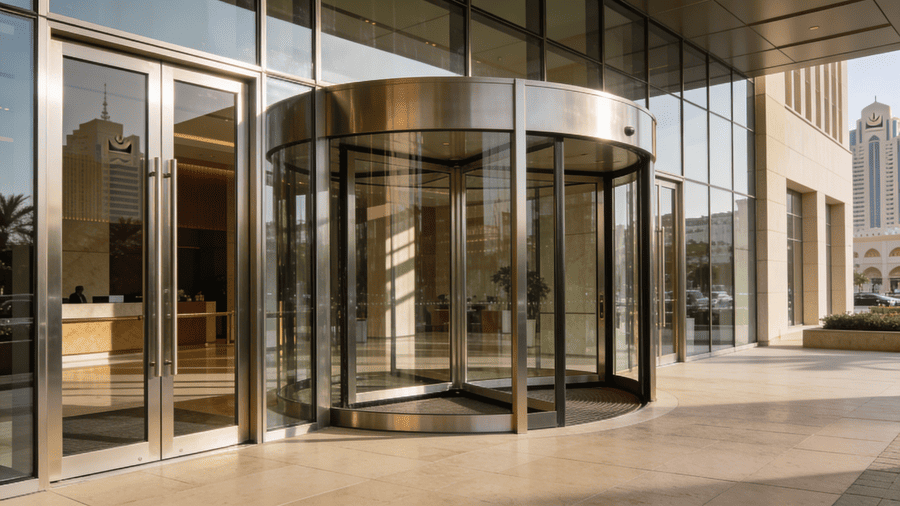
Automatic revolving doors are quickly becoming a key element in modern building design across the GCC, where energy efficiency, indoor comfort, and long‑term operating costs are now as important as architecture and convenience. In commercial towers, hotels, shopping malls, hospitals, and mixed‑use developments, every entrance plays a role in how much cooled air escapes and how hard the HVAC system must work. In a region where outdoor temperatures regularly exceed 40°C, the loss of conditioned air through frequently used entrances can place significant pressure on cooling systems. This is one reason automatic revolving doors are often recommended as an energy‑saving entrance solution for buildings in Dubai, Abu Dhabi, and other Middle Eastern cities.
How Revolving Doors Work
The principle behind revolving doors is simple but highly effective. Unlike standard sliding or swing doors, which create a direct opening between the interior and exterior, revolving doors use rotating compartments that remain in constant motion. This design maintains a physical barrier between indoor and outdoor spaces, limiting the rush of hot air, dust, and humidity into the building every time someone passes through. In hot climates like the GCC, reducing this air infiltration helps keep indoor temperatures more stable and reduces the load on chillers and air‑handling units.
The Real Energy‑Saving Benefit
One of the strongest arguments in favor of automatic revolving doors is their ability to reduce the strain on HVAC systems. In busy commercial entrances, conventional automatic doors may open hundreds or even thousands of times a day, allowing large volumes of cooled air to escape while hot outdoor air pours in. Revolving doors help minimize that exchange, leading to more consistent indoor conditions and improved energy performance. For hotels, malls, office towers, and healthcare facilities, this can translate into lower electricity consumption, reduced peak load demands, and meaningful savings on operating costs over time.
Where Marketing Can Overstate the Value
Although the benefits are real, revolving doors are not a universal solution for every building. Their best performance is usually seen in high‑traffic environments where the entrance is used continuously throughout the day. In low‑ or medium‑traffic buildings, the difference in energy savings may be modest. This is where marketing can sometimes overstate the technology’s impact, presenting it as a standalone “magic fix” for energy efficiency. In practice, the real value depends on factors such as traffic volume, door usage patterns, and whether the revolving door is actually the primary entrance people use rather than a secondary or cosmetic option.
Why GCC Conditions Matter
The GCC climate adds another layer of complexity to entrance design. In cities like Dubai, Abu Dhabi, Doha, and Riyadh, revolving doors must endure extreme heat, intense solar radiation, sand and dust, and occasional humidity. These conditions can stress motors, sensors, seals, and materials over time if the system is not engineered for the region. That is why climate‑specific design and components are essential. A revolving door that performs well in temperate European climates may not deliver the same durability or efficiency in the Gulf unless it is built for local conditions, including robust sealing, dust‑resistant components, and thermally stable structural elements.
More Than Energy Efficiency
Automatic revolving doors also offer benefits beyond reducing energy use. They help improve indoor comfort by limiting the sudden bursts of hot air that can occur with conventional doors, creating a more stable microclimate just inside the entrance. They also help control dust, noise, and external odors, which is important in premium hotels, office lobbies, and healthcare facilities. From a branding perspective, revolving doors often convey a sense of quality, modernity, and prestige that aligns with high‑end developments. Because of this, they are commonly specified in luxury hotels, landmark towers, and upscale commercial buildings across the region.
Final Thought
Automatic revolving doors are not just a marketing trend or a decorative feature. In the right context—especially in high‑traffic entrances in very hot climates—they can be a practical and effective solution for reducing air infiltration and supporting better energy performance. However, they are not a one‑size‑fits‑all answer. The real value depends on traffic levels, installation quality, long‑term maintenance, and whether the system is engineered for the demands of the Middle East. When all these factors are aligned, automatic revolving doors can be one of the smartest entrance strategies for hot‑climate commercial buildings.