



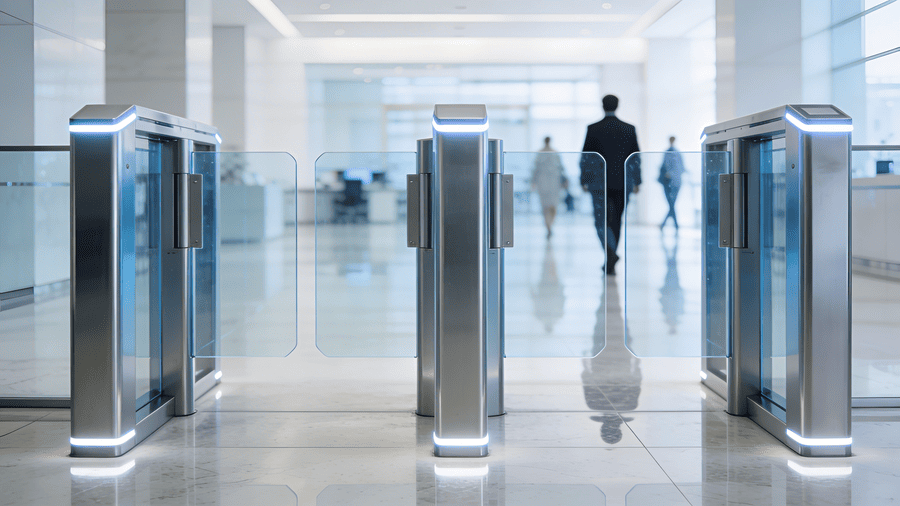
In this article, we compare both options for Qatar’s high‑traffic environments such as office towers, transport hubs, government facilities, and mixed‑use developments.
What Are Automatic Speed Gates?
Automatic speed gates are motorized pedestrian barriers designed for fast, controlled passage, typically using glass swing or sliding panels with intelligent sensors. They are widely used in premium lobbies, corporate headquarters, banks, and government buildings where image, comfort, and security must work together.
Key characteristics:
- Motorized glass wings (sliding or swing) with fast open/close cycles
- Integrated sensors to detect users, prevent contact, and reduce tailgating
- Sleek, modern design that blends with high‑end interior finishes
- Easy integration with access control, biometrics, and visitor management systems
What Are Traditional Turnstiles?
Traditional tripod or full‑height turnstiles are mechanical or electromechanical barriers that rotate to allow one person at a time. They are a familiar solution in stadiums, factories, and basic staff entrances where robustness and cost take priority over premium aesthetics.
Key characteristics:
- Mechanical arms or rotating cages controlling one‑by‑one access
- Generally lower initial cost per lane
- Rugged construction suitable for harsh or industrial environments
- A more utilitarian look that may not suit prestige lobbies
Key Comparison: Speed Gates vs Turnstiles in Qatar
1. Throughput and Flow in High‑Traffic Buildings
In busy Doha office towers or metro‑adjacent developments, every second counts during morning and evening peaks. Automatic speed gates typically offer higher throughput because the glass panels open and close quickly and allow smooth, natural walking movement. Traditional tripod turnstiles slow people down, require a more deliberate push, and can quickly create queues at peak times.
For towers, corporate HQs, and transport‑linked buildings, speed gates are usually the better choice to keep pedestrian traffic flowing and avoid congestion in the lobby.
2. User Experience and First Impressions
The main entrance is often the “front door” to your brand. Automatic speed gates offer a premium, contactless passage experience that aligns with modern, air‑conditioned, well‑designed lobbies in Qatar. Visitors and staff simply tap their card or present a QR/biometric, and the lane opens smoothly.
Traditional turnstiles can feel more like a barrier than a welcoming entrance. They may still be acceptable for staff entrances, back‑of‑house areas, or industrial facilities, but they rarely match the expectations of Grade A commercial or government buildings in Doha and Lusail.
3. Security and Anti‑Tailgating Performance
Both technologies can enforce access control, but they perform differently. Speed gates with advanced sensors can detect tailgating and unauthorized entries more reliably, especially in high‑traffic scenarios. Glass panels can close quickly behind each authorized user, reducing the chances of someone slipping through.
Traditional tripod turnstiles provide basic one‑by‑one control, but determined tailgaters can sometimes push through or follow closely. Full‑height turnstiles improve on this, but they are visually heavy and not suitable for most corporate lobbies.
4. Integration with Smart Building Systems
Qatar’s new projects increasingly follow smart building and smart city concepts, integrating access control with elevators, visitor management, CCTV, and building management systems. Automatic speed gates are designed for this type of integration, supporting:
- Card, PIN, QR, or mobile access
- Biometric readers (face, fingerprint, palm)
- Visitor kiosks and reception systems
- Alarm and fire systems for emergency mode
Traditional turnstiles can be integrated as well, but they typically offer less space and flexibility for multiple readers, screens, or advanced devices. For technology‑rich projects, speed gates give more options and a cleaner installation.
5. Aesthetics and Architectural Fit
For architects and interior designers, entrance equipment must complement the overall design. Speed gates are available with:
- Glass panels of different heights
- Custom cladding (stainless steel, powder‑coated, stone, wood, etc.)
- LED guidance lighting and sleek tops for mounting readers
This makes them ideal for corporate headquarters, banks, ministries, and VIP entrances. Traditional turnstiles, by contrast, are more functional in appearance and can clash with premium finishes if placed in the main lobby.
6. Safety, Accessibility, and Comfort
Speed gates can be configured with wider lanes for wheelchair users, trolleys, and deliveries, while maintaining a visually consistent line of barriers. Sensors help reduce accidental contact, and smooth operation feels safer and more comfortable, especially in crowded situations.
Traditional tripod turnstiles usually require a separate, dedicated gate for wheelchairs or VIPs, which can create a “two‑tier” experience. Full‑height turnstiles can also feel intimidating for some users and may not be appropriate for public‑facing or VIP environments.
7. Cost, Lifecycle, and Return on Investment
Traditional turnstiles usually have a lower upfront cost per lane, which can be attractive for smaller budgets or purely functional areas. However, in Qatar’s high‑value buildings, long‑term considerations matter:
- Speed gates enhance the building’s perceived quality and value
- Faster throughput reduces staff congestion and waiting time
- Better integration with smart systems can reduce manual checks and staffing
Over the life of the building, speed gates can deliver a stronger return on investment by combining security, efficiency, and image in one solution. Turnstiles remain relevant where cost and ruggedness are more important than look and feel.
Where Automatic Speed Gates Are the Better Choice in Qatar
Automatic speed gates are typically the best fit for:
- Grade A office towers and corporate HQs
- Government ministries and financial institutions
- Mixed‑use developments and high‑end residential towers
- Transport‑linked buildings (near metro, bus, or park‑and‑ride)
- Any project targeting a modern, smart‑building image
In these environments, they balance security, speed, and aesthetics while supporting advanced integrations and future upgrades.
Where Traditional Turnstiles Still Make Sense
Traditional turnstiles remain a practical choice for:
- Industrial facilities and warehouses
- Staff entrances away from the main lobby
- Stadiums, construction sites, and rugged outdoor locations
- Projects with very tight budgets where aesthetics are not a priority
In these cases, robustness and basic access control take priority over premium looks and advanced integrations.
So, What Works Best for Qatar’s High‑Traffic Buildings?
For most high‑traffic, public‑facing buildings in Qatar, automatic speed gates are the better long‑term choice. They provide faster throughput, a premium user experience, stronger integration with smart building systems, and a visual standard that matches modern Doha and Lusail developments. Traditional turnstiles still have their place in back‑of‑house, industrial, and budget‑driven environments, but they are no longer the ideal solution for prestige lobbies and smart projects.