



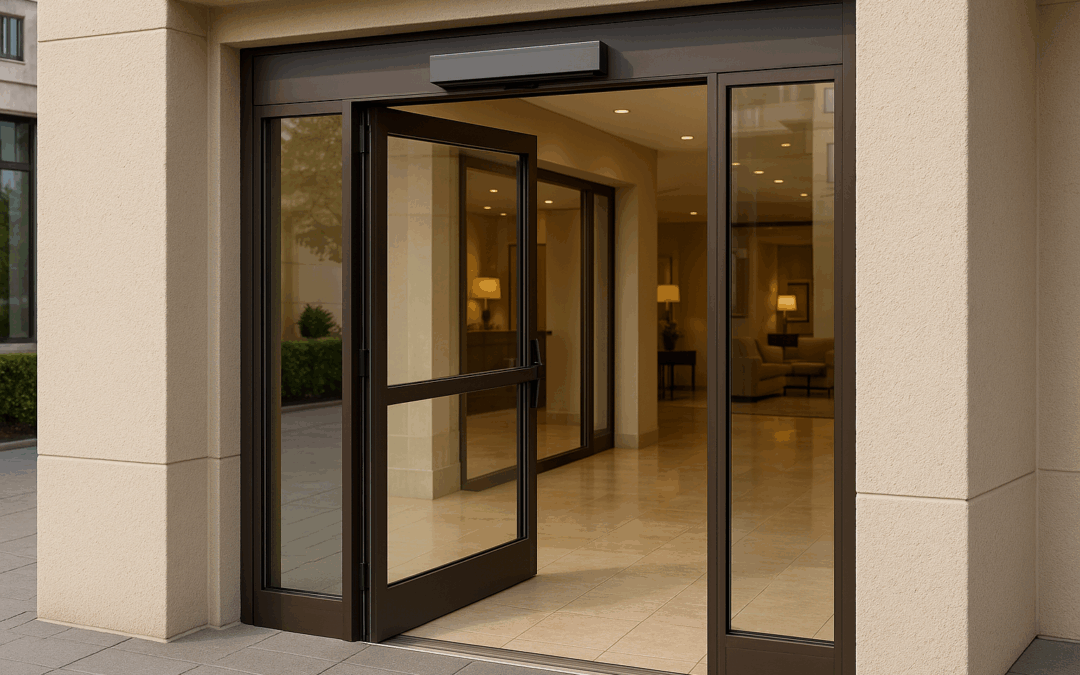
Automatic swing doors are widely adopted in commercial, healthcare, and residential environments because they combine accessibility, automation, and architectural compatibility in a single entrance solution. While they may appear simple from the outside, their internal components and control logic are carefully engineered to deliver precise, safe, and reliable operation. From hospitals and office lobbies to luxury villas and controlled‑access corridors, automatic swing doors are designed to respond to real‑time user needs without compromising on safety or aesthetics.
Core Components of an Automatic Swing Door
The primary element of any automatic swing door system is the operator unit, which drives the door leaf. Operators can be either electro‑mechanical or electro‑hydraulic, chosen based on performance requirements such as opening speed, load capacity, and frequency of use. The operator is usually housed in a surface‑mounted casing above the door or concealed within the header for a cleaner, more integrated look.
Motion is transferred from the operator to the door leaf through an arm system, which can be configured as a sliding, push, or pull arm depending on the door orientation, swing direction, and available space. These arms are designed to operate smoothly and quietly, even under heavy‑use conditions, while minimizing wear on hinges and frames in the Automatic Swing Doors System.
Activation and Safety Mechanisms
Automatic swing doors are activated through a range of input devices, including microwave motion sensors, infrared presence detectors, push buttons, and touchless switches. These devices detect user approach or request and send a signal to open the door, enabling contactless access that is especially useful in healthcare and hygiene‑sensitive areas.
To ensure user safety, modern systems integrate safety sensors in Automatic Swing Dooors, that detect obstructions in the door’s path. These sensors may be mounted above the door, on the leaf itself, or at floor level. In high‑traffic or public environments, compliance with standards such as EN 16005 is essential, requiring the door to detect people and objects both before and during motion to prevent collisions and crushing hazards.
Types of Door Operators
Automatic swing door operators fall into three main categories:
-
Full‑energy operators are designed for high‑speed opening and closing cycles, suitable for busy environments such as hospitals, airports, and major commercial complexes. Due to their power and speed, they require advanced safety detection and often include multiple sensors and controlled‑speed profiles.
-
Low‑energy operators work at slower speeds and with reduced force, making them ideal for spaces where safety and accessibility are priorities, such as clinics, office entries, and residential buildings. They typically comply with reduced force and timing limits and are often used in designs that need to meet DDA‑style accessibility requirements.
-
Power‑assist operators provide motor assistance during manual operation. The user starts the opening manually, and the motor of the Automatic Swing Door takes over to reduce physical effort. These are commonly used in retrofitted doors or areas where full automation is not required but accessibility support is still beneficial.
Logic Programming and Control Settings
The control board within the operator serves as the brain of the system. Technicians can program a wide range of parameters, including hold‑open time, opening and closing speeds, delay functions, push‑and‑go activation, and integration with lock controls. This flexibility allows the door to be tuned to the specific usage pattern of each location, from high‑traffic public entrances to low‑use internal corridors.
In advanced systems, the door can also interface with building automation or access control platforms, enabling coordinated management of entrances across the facility. Emergency features such as automatic fail‑open during a fire alarm signal can be configured, ensuring that safety and egress requirements are met while still maintaining controlled access when needed.
Installation Considerations
When planning an automatic swing door installation, several factors must be addressed early: clear opening dimensions, hinge orientation, load‑bearing surface requirements, power availability, and wiring routes for sensors and control connections. The type of wall and floor structure determines whether surface‑mounted or concealed solutions are feasible and how the components can be integrated without compromising structural integrity.
In retrofit situations, it is also important to evaluate whether the existing manual door and frame can support automated operation, or if reinforcement, realignment, or frame modifications are required. Incorrect or rushed installation can lead to uneven movement, increased wear, and reduced safety performance, so proper planning and alignment are critical.
Ideal Applications
Automatic swing doors are highly versatile and can be adapted to a wide range of environments. In healthcare settings, they support hands‑free access and hygiene protocols by minimizing physical contact points. In office buildings and hotels, they provide a seamless, modern entry experience that aligns with premium building standards. For luxury villas and high‑end residential projects, concealed swing operators offer minimal visual impact while still delivering high‑performance automation.
Each application places different demands on operator strength, activation logic, and integration features. Public corridors may require high‑speed, full‑energy operators with multiple sensors, whereas internal residential doors can function efficiently with low‑energy or power‑assist solutions. This is why proper specification and customization are essential to ensure the right balance between performance, safety, and design.
Conclusion
Automatic swing doors are more than a simple convenience—they are sophisticated systems engineered to support safety, accessibility, and architectural intent. In high‑traffic commercial buildings, patient‑centric healthcare facilities, and refined residential properties, the correct choice of operator, sensor configuration, and installation approach makes a significant difference in daily performance and long‑term reliability. Understanding the technical design, control logic, and space‑specific requirements helps architects, consultants, and facility managers make informed decisions. Working with a trusted supplier ensures that each project benefits from both engineering precision and real‑world installation experience.