




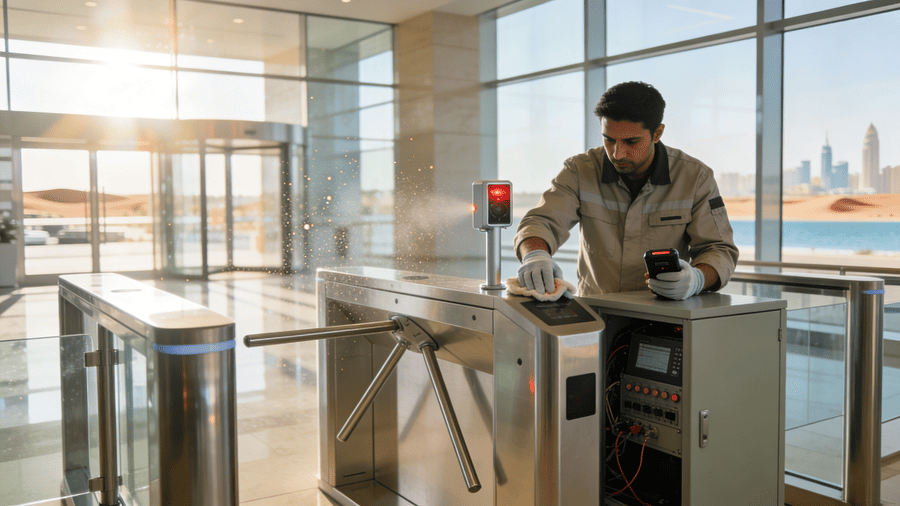
In Dubai’s demanding environment, speed gates and turnstiles operate under conditions that are far more challenging than in many other global cities. High temperatures, airborne dust, humidity swings, and heavy daily footfall all contribute to faster wear and tear. Without a structured maintenance strategy, even advanced access control systems can suffer premature failure.
If your facility relies on pedestrian access systems for security, compliance, and operational flow, proactive maintenance is not optional—it is essential.
Understanding Dubai’s Environmental Impact on Access Systems
Facilities in Dubai face extreme summer temperatures that often exceed 45∘C45^\circ\text{C}, along with dust intrusion and (in coastal areas) humidity and salt exposure. These stressors commonly affect:
-
Motor assemblies and drive mechanisms
-
Control boards and power supplies
-
Infrared safety sensors
-
Stainless steel finishes and glass panels
-
Biometric and RFID readers
Dust accumulation inside cabinets can lead to overheating. Humidity can trigger corrosion in connectors and terminals. Sudden voltage fluctuations can damage control boards.
In high-traffic environments such as commercial towers, metro stations, data centers, and government facilities, daily operating cycles can exceed manufacturer baseline assumptions—accelerating mechanical fatigue.
Core Maintenance Areas for Speed Gates and Turnstiles
1) Mechanical components
Routine inspection of motors, gearboxes, bearings, and arms is critical. Lubrication schedules should be adapted to Dubai’s dust-heavy conditions, where fine particles can mix with grease and form abrasive compounds.
Check for:
-
Arm alignment deviations
-
Unusual vibration or noise
-
Slow opening/closing cycles
-
Excessive motor heat
Even minor mechanical misalignment, when ignored, often leads to premature motor or gearbox replacement.
2) Electrical and control systems
Speed gates and turnstiles rely on control logic boards and integration modules (access control, fire alarm interface, BMS, etc.). Preventive checks should include:
-
Tightening terminals and checking grounding
-
Inspecting PCB boards for heat marks or discoloration
-
Testing backup battery and emergency power behavior
-
Applying approved firmware updates (where applicable)
In UAE installations, voltage stabilizers and surge protection are strongly recommended to reduce damage from fluctuations.
3) Sensors and safety systems
Infrared beams, presence sensors, and anti-tailgating sensors need periodic cleaning and calibration. Dust can block or distort beam accuracy, leading to false alarms, nuisance stops, or unintended unlocking.
Maintenance should include:
-
Sensor cleaning (lenses and emitters/receivers)
-
Recalibration and alignment verification
-
Tailgating detection testing
-
Emergency fail-safe verification (including fire alarm release behavior where required)
Safety compliance testing is especially important in government and enterprise facilities.
4) Stainless steel and aesthetic surfaces
In coastal zones near the Arabian Gulf, chloride exposure can affect even grade 304 stainless steel over time. For long-term durability:
-
Clean using non-corrosive, stainless-safe agents
-
Avoid abrasive pads or harsh chemicals that scratch and accelerate staining
-
Inspect weld points and edges for early corrosion
For premium sites, cosmetic degradation also impacts brand image and can signal poor maintenance practices.
Recommended Preventive Maintenance Schedule (UAE)
For Dubai-based facilities, this PPM structure is typically effective:
-
Monthly: Visual inspection and cleaning
-
Quarterly: Mechanical and electrical functional testing
-
Bi-annual: Full system diagnostics and recalibration
-
Annually: Component wear assessment and lifecycle planning
High-footfall sites (metro, stadiums, government service centers, large business hubs) may require shorter cycles based on actual throughput and operational hours.
When to Consider Component Replacement
Instead of waiting for a breakdown, track indicators that signal end-of-life or rising failure risk:
-
Motor cycle count and rising current draw
-
PCB heat damage, recurring faults, or unstable behavior
-
Frequent sensor recalibration needs or repeated false alarms
-
Slower response times and inconsistent opening/closing cycles
A lifecycle-based maintenance approach reduces downtime, improves user flow, and avoids costly emergency call-outs.
Final Thoughts
Speed gates and turnstiles are not simple barriers—they are precision access control systems. In Dubai’s climate, reactive maintenance increases operational risk and accelerates failure.
A structured preventive maintenance program helps ensure:
-
Longer equipment lifespan
-
Reduced downtime
-
Stronger safety compliance
-
Lower long-term costs
-
More reliable security and access flow
If your facility depends on access integrity, investing in professional maintenance is a strategic operational decision—not just a service expense.